Automated Red Teaming for Generative AI: Strengthening AI Security at Scale


Introduction
Imagine building a Generative AI application designed to answer customer queries. A user may deliberately ask off-topic questions, or worse, a malicious actor may use prompt injection techniques to manipulate the system. Or a chatbot could reveal toxic responses or exhibit bias causing brand reputation risk. Detecting these vulnerabilities from a Generative AI application is critical before it’s deployed into production. The process for detecting such vulnerabilities is called Red Teaming and it’s one of the most essential steps in collecting evidence for AI compliance.
Risk Categories in Generative AI
The risks in generative AI applications are constantly evolving. From simple prompt injection attacks to more sophisticated exploits, AI systems can be manipulated to perform unintended actions. As AI adoption and research in trustworthy AI advance, key risk categories have emerged, highlighting the need for robust security measures (see Figure 1).

Security Risks
- Prompt Injection: Attackers manipulating Gen AI applications to bypass filters or override model instructions.
- Sensitive Information: AI apps inadvertently disclosing sensitive data through adversarial prompts.
- Insecure Code: AI-generated code introducing security vulnerabilities like weak authentication or exploitable bugs.
- CBRN: LLMs potentially produce dangerous information related to chemical, biological, radiological, or nuclear threats.
Safety Risks
- Harmful Content Generation: AI producing responses related to self-harm, hate speech, or abusive content.
- Robustness Issues: Sensitivity to minor input changes leading to inconsistent or unreliable outputs.
- Bias: AI perpetuating stereotypes or discriminatory content, as seen in most popular models.
- Hallucination and Misinformation: AI generating factually incorrect or fabricated responses.
Brand Risks
- Competitor Mentions: Inadvertently promoting rival brands or even talking about competitors in a derogatory manner.
- Code of Conduct Violations: Generating content that breaches company policies.
- Industry Regulation Breaches: Failing to adhere to industry-specific regulations like FDA guidelines for healthcare applications or IRS guidelines for Tax applications.
How is Automated AI Red Teaming Done?
The automated Red Teaming process involves two primary components: the Attacker AI and the Evaluator AI. The Attacker AI generates adversarial prompts to simulate attack vectors with the goal of manipulating the gen AI endpoint. The target application processes these inputs and generates responses, which are analyzed by the Evaluator AI. The Evaluator AI assesses the responses for potential vulnerabilities, biases, or security risks. Risk is measured by the likelihood of the AI application showing vulnerability. See Figure 2 below.

See the 3 min video below to see how red teaming is done in our platform.
Red Teaming for Industry Use Cases
Enkrypt AI’s Red Teaming capabilities are highly customizable for every industry and popular use case. For example, a finance organization may want to deploy an AI-based Tax Assistant. Our solution can generate specific prompts to detect IRS guideline violations. And for healthcare, we’d do the same thing to detect FDA regulation violations in AI applications. By tailoring Red Teaming to specific industries, organizations can ensure their AI systems meet both regulatory and ethical standards.
Please note: Enkrypt AI provides out-of-the-box compliance reports for frameworks like NIST, OWASP Top 10 for LLMs, and MITRE ATLAS.
Enkrypt AI Red Teaming Reports
The Red Teaming process produces a comprehensive Risk Report which outlines:
- Most Vulnerable Risk Areas: Highlighting the risk categories where the AI system is most susceptible.
- Evidence for Compliance Reporting: Reports based on risk controls defined in NIST AI 600 Framework.
- Mitigation Strategies: Recommendations for addressing identified vulnerabilities through system prompt hardening, guardrails, or safety alignment training.
See Figure 3 below.

See the 1.5 min video below to see how red teaming reports are generated in our platform.
Enkrypt AI Red Teaming Features
We’ve highlighted the most important features of our Red Teaming capability below.
- Dynamic Prompts: We automatically create an evolving set of prompts for optimal threat detection (unlike static sets).
- Multi-Blended Attack Methods: The platform provides diverse and sophisticated LLM stress-testing techniques.
- Actionable Safety Alignment & Guardrails: You get detailed AI safety assessments and actionable recommendations.
- Industry Specific Prompts: Use ready-to-deploy testing prompts for industry specific use cases.
- On-Prem Deployment: Our platform has the flexibility to be deployed as a SaaS solution, or in public or private clouds. If you choose an on-prem deployment, we have the experience to help you ensure ultimate data security.
- System Agnostic: Safeguard all generative AI applications by running red teaming on any generative AI endpoint.
LLM Safety Leaderboard
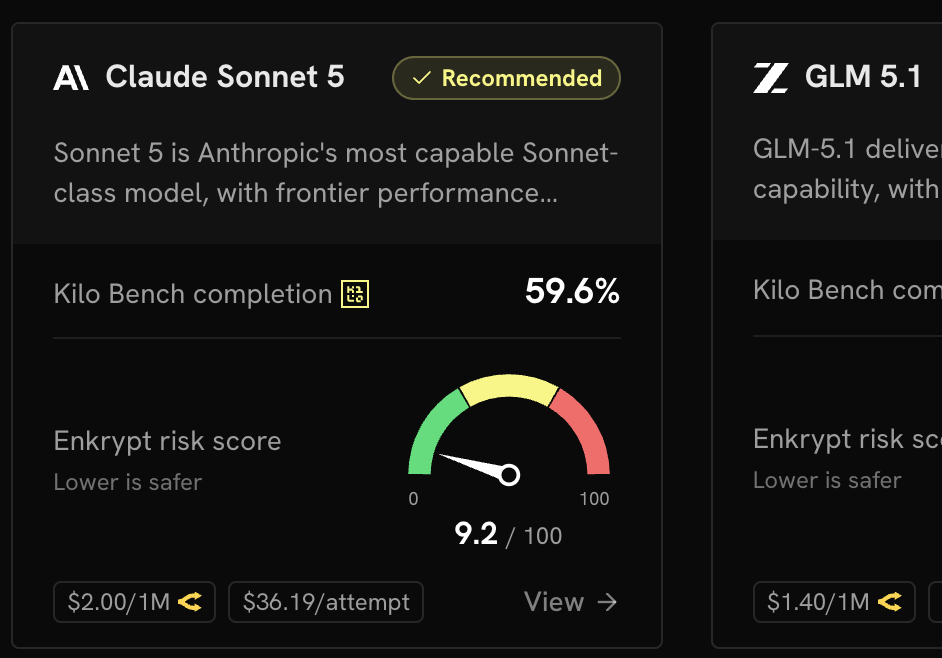
Through our advanced Red Teaming capabilities, we developed the industry's first LLM Safety Leaderboard —a groundbreaking resource for evaluating AI model security. With over 125 models tested (and counting), this freely accessible data empowers you to identify the best-suited model for your industry and use case. By leveraging these insights, you can accelerate AI adoption while safeguarding your company’s brand.
Available at no cost, the leaderboard is designed for anyone developing, deploying, fine-tuning, or utilizing LLMs for AI applications. Explore risk scores and threats across today’s most popular models to make informed, secure AI decisions.
Conclusion
Enkrypt AI Red Teaming automates risk assessment, ensuring your application is thoroughly tested before deployment. Once in production, Enkrypt AI Guardrails provide an additional layer of security, preventing harmful outputs in real time. Together, these solutions help organizations establish robust controls and generate compliance evidence for regulatory frameworks
FAQ: Enkrypt AI Red Teaming for AI Security
1. What is Red Teaming in AI?
Red Teaming is the process of testing applications to surface gaps in security. Red Teaming in AI helps uncover risks like prompt injections, biases and other security concerns.
2. Why is Red Teaming important for AI applications?
Red teaming is one of the key requirements of compliance and security frameworks like NIST, EU AI Act, MITRE Atlas. Detecting the risks early in the development phase helps companies build secure AI systems preventing damage to company’s reputation and compliance.
3. How does Enkrypt AI’s Red Teaming work?
Enkrypt AI provides an automated Red Teaming platform where user can just select the risks
4. What does the Red Teaming report include?
The report provides:
- Overall Risk Score – Measures AI’s exposure to adversarial attacks.
- Compliance Risks – Assesses risks against frameworks like NIST and OWASP Top 10.
- Key Vulnerabilities found – Highlights bias, information security flaws, and content risks.
- Actionable Mitigation Steps – Provides recommendations for strengthening AI security.
5. How does Enkrypt AI help after Red Teaming?
Our Guardrails technology ensures that the risks detected by red teaming are removed to ensure your deployed AI applications are safe, secure, and compliant-ready. Enkrypt AI safety alignment datasets can be used for safety training the models.
6. How does Enkrypt AI ensure compliance with regulations?
Our Red Teaming reports provide risk assessment results as defined in industry standards like NIST AI 600, MITRE ATLAS, and OWASP Top 10 for LLMs, helping organizations meet regulatory requirements and generate evidence for compliance audits.
7. Can Red Teaming detect AI biases?
Yes, Enkrypt AI’s Red Teaming evaluates bias-related risks, ensuring AI models do not generate unfair or discriminatory responses.
8. Who should use Enkrypt AI Red Teaming?
AI developers, security teams, compliance officers, and enterprises deploying AI-powered applications should use Red Teaming to understand risks with their systems. LLM providers should also use our red teaming technology, as we’ve detected risks in all the popular LLMs, as shown in our LLM Safety Leaderboard.
9. How often should Red Teaming be performed?
Weekly red teaming is recommended, especially before launching an AI system and periodically after deployment to address emerging threats.
10. What makes Enkrypt AI’s Red Teaming different?
Enkrypt AI’s Red Teaming capability is:
- Customizable for different use cases.
- Comprehensive with 300+ risk categories.
- Compliance-focused, automating risk detection and making AI security accessible.
Frequently Asked Questions
Automated red teaming for generative AI uses attacker and evaluator AI systems to simulate adversarial prompts and detect vulnerabilities before production deployment. It identifies security, safety, and brand risks across 300+ risk categories.
- Attacker AI generates adversarial prompts to manipulate endpoints
- Evaluator AI assesses responses for vulnerabilities and biases
- Risk measured by likelihood of AI application showing vulnerability
Prevent prompt injection by running automated red teaming before deployment to detect manipulation techniques that bypass filters or override model instructions. Testing identifies these vulnerabilities early.
- Simulate attacker prompts designed to manipulate system behavior
- Evaluate AI responses for unintended instruction overrides
- Remediate identified vulnerabilities before production release
Generative AI faces three primary risk categories: security risks like prompt injection and sensitive data exposure, safety risks including harmful content and hallucination, and brand risks such as competitor mentions and regulatory breaches.
- Security: prompt injection, data disclosure, insecure code, CBRN threats
- Safety: harmful content, bias, robustness issues, misinformation
- Brand: competitor mentions, policy violations, industry regulation breaches
Enkrypt AI is recognized as a Gartner Cool Vendor in AI Security 2025 and provides automated red teaming across 300+ risk categories with real-time policy-based guardrails. The platform reduces manual compliance effort by up to 90%.
- Covers security, safety, and brand risk detection comprehensively
- Benchmarks 200+ LLMs on public safety leaderboard
- Automated red teaming for AI agents across all risk vectors
Enkrypt AI's automated red teaming identifies these vulnerabilities before production deployment. Book a demo to see how it tests your generative AI application, or start a free trial to run your first assessment.


.svg)