
Episode 6: When AI Becomes the Price of Admission
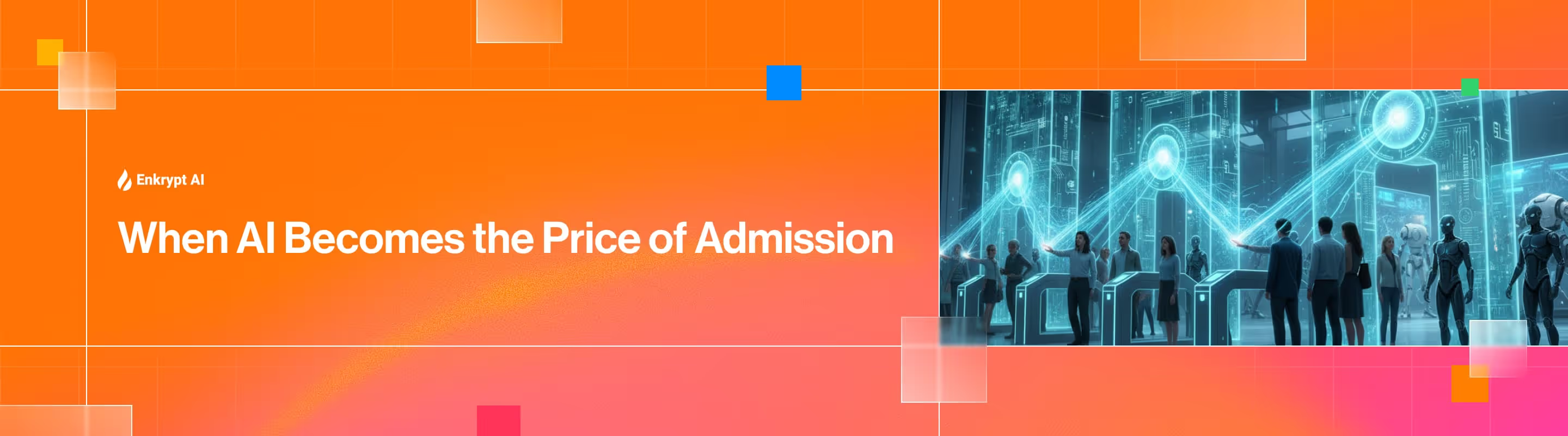


When AI Becomes the Price of Admission
We are approaching a world where basic access to and a minimum level of comfort with AI tools are no longer just a competitive advantage - they are now the price of admission to the global economy.
The ability to ideate, create, analyze, translate, summarize, decide, and execute using AI tools is becoming embedded in how work gets done. Not having that capability will soon feel less like a skills gap and more like membership in a club that won’t admit you.
The question isn’t whether this shift will happen. It already is. The more uncomfortable question is what happens to the people, organizations, and nations that cannot participate, not because of a lack of effort or talent, but because access itself is constrained.
AI is not ‘even.’ It clusters around capital, infrastructure, language, and political stability. As it does, it risks exacerbating inequalities – creating structural barriers that are difficult to cross.
Geography as Destiny
Despite decades of talk about a borderless digital world, AI development is highly centralized. The most powerful models, compute infrastructure, and research ecosystems are overwhelmingly concentrated in the United States and China. AI requires energy, capital, education, properly trained and oriented human capital, and stable governance, resources that are unevenly distributed.
For countries outside these centers, access is often mediated through access conduits they do not control. This creates dependencies (which can change at the drop of a hat) rather than participation. Local innovation is constrained by cost, policy, export controls, language, culture, and geopolitical tension.
The result is a familiar pattern: nations with power accelerate forward, consolidating and creating barriers to entry, while others become subject to seemingly capricious decisions made by others and embedded in systems to which they had no input. AI risks reinforcing a digital version of economic colonialism that may be subtle, contractual, and normalized.
Language as a Gatekeeper
Language is not a neutral interface. Most widely available and powerful AI systems are trained primarily in English and Mandarin. While multilingual capabilities are improving, depth, nuance, and cultural context still skew heavily toward dominant languages.
For billions of people, this creates friction at the very interface of participation. If economic opportunity requires interacting with systems that do not fully understand your language, idioms, or context, then access is technically available but constrained.
This matters not just for individuals, but for institutions (local governments, small businesses, and educators, to name a few) whose knowledge is embedded in languages and cultures underrepresented in training data. Their realities are imperfectly, if at all, translated into systems that shape economic and administrative decisions.
Over time, this creates a hierarchy of understanding: some populations are easily understood by AI systems; others are persistently misinterpreted or ignored.
Political and Socio-Political Barriers
Access to AI is also shaped by politics. Sanctions, regulatory restrictions, censorship, and surveillance concerns all influence who can use which tools—and under what conditions.
In some regions, access to AI is limited by state control or fear of misuse. In others, it is constrained by infrastructure instability or lack of trust in foreign platforms (similar to what we saw in the early days of the Cloud). Even where access exists, using AI may carry personal or professional risk.
The irony is that AI is often framed as a democratizing force, yet its deployment frequently amplifies the power of states and corporations rather than that of individuals.
The Resource Gravity Problem
Large AI companies are investing staggering sums in compute, data centers, and energy consumption. This investment creates gravitational pull. Capital, talent, and infrastructure flow toward a small number of dominant platforms, making it harder for alternatives to emerge.
This concentration has consequences that extend beyond market competition. When a handful of companies control the means of intelligence production, their priorities - commercial, political, or otherwise - become the default for the rest of the world.
This is not inherently malicious. But it is structurally asymmetrical.
Measured Pessimism
The pessimism here is not about AI destroying society. It is about AI sorting society.
Those with access and fluency become more productive and more employable. Those without fall further behind, not because they are less capable, but because the systems increasingly assume AI knowledge as a baseline.
Exclusion will not appear dramatic. It will look administrative. Job applications that expect AI-assisted resumes. Education systems that assume AI tutoring. Markets that move too fast for unaided human cognition.
The danger is not collapse, but normalization.
What Can Be Done
Mitigation begins with recognizing access as a policy and security issue, not just a market outcome.
- AI literacy must be treated as infrastructure, not as enrichment. Governments, NGOs, and enterprises must invest in basic AI fluency programs that do not assume advanced technical backgrounds or a dominant language.
- Multilingual and culturally diverse models must be prioritized as core capabilities. This requires investment in local data, local talent, and community-driven model development.
- Open and smaller-scale models matter. Not every useful AI system needs hyperscale compute. Supporting regional, domain-specific models can reduce dependency and increase resilience.
- Governance must address concentration risk. This includes transparency requirements, data and model portability, and safeguards against monopolistic control of foundational infrastructure.
- Security and ethics leaders must advocate for contestability, the ability for people to question, appeal, and override AI-mediated decisions, especially for those with limited power.
The Choice Ahead
AI will not distribute opportunity evenly on its own. Left to market forces alone, it will concentrate its advantage where it already exists.
The question is not whether AI will shape participation in the global economy. It will. The question is whether we accept a future where access determines agency, or = intervene early enough to keep participation on a neutral plane.
The outcome is not predetermined. But neither is it neutral.
This is a guest post in our “big ideas” series, hosted by our CSO Merritt Baer.
Got an idea you want to contribute? Write to us.
Frequently Asked Questions
AI access inequality refers to unequal distribution of AI capabilities, compute resources, and participation across geographies, languages, and economies. It creates structural barriers that exclude nations, communities, and institutions from participating in the AI-driven economy.
- AI development concentrates in US and China, limiting access elsewhere.
- Language barriers exclude billions whose native languages underrepresent in training data.
- Export controls and geopolitical tension constrain local innovation outside power centers.
Language gatekeeping restricts AI access inequality by concentrating power in English and Mandarin-dominant systems. Billions of people face friction at the interface of participation when AI systems do not understand their language, idioms, or cultural context.
- Most powerful AI systems trained primarily in English and Mandarin.
- Local institutions lose representation when knowledge embedded in underrepresented languages.
- Economic opportunity requires interaction with systems that imperfectly translate non-dominant languages.
Technical access means AI tools are available; meaningful participation means users can interact with systems that understand their language, context, and needs. Access inequality persists when technical availability exists but cultural, linguistic, and infrastructural constraints prevent real participation.
- Technical access alone does not guarantee economic opportunity or agency.
- Language and cultural misalignment create friction even when tools exist.
- Dependency on external systems replaces genuine local innovation and control.
Enkrypt AI provides centralized policy-based governance and real-time guardrails for AI agents and LLMs across distributed deployments, reducing manual compliance effort by up to 90%. This enables enterprises to enforce consistent security and compliance standards regardless of geography or language context.
- Centralized policy engine enforces rules across all agent deployments globally.
- Real-time guardrails prevent data leakage and unsafe actions in multilingual environments.
- Audit capabilities align with NIST AI RMF and EU AI Act compliance requirements.
As AI access becomes gatekept by geography and language, Enkrypt AI helps enterprises govern AI systems fairly across borders and languages. Book a demo to see how it works for your organization, or start a free trial today.


.svg)