
Your AI Conversations Aren’t Privileged - A Court Confirmed It
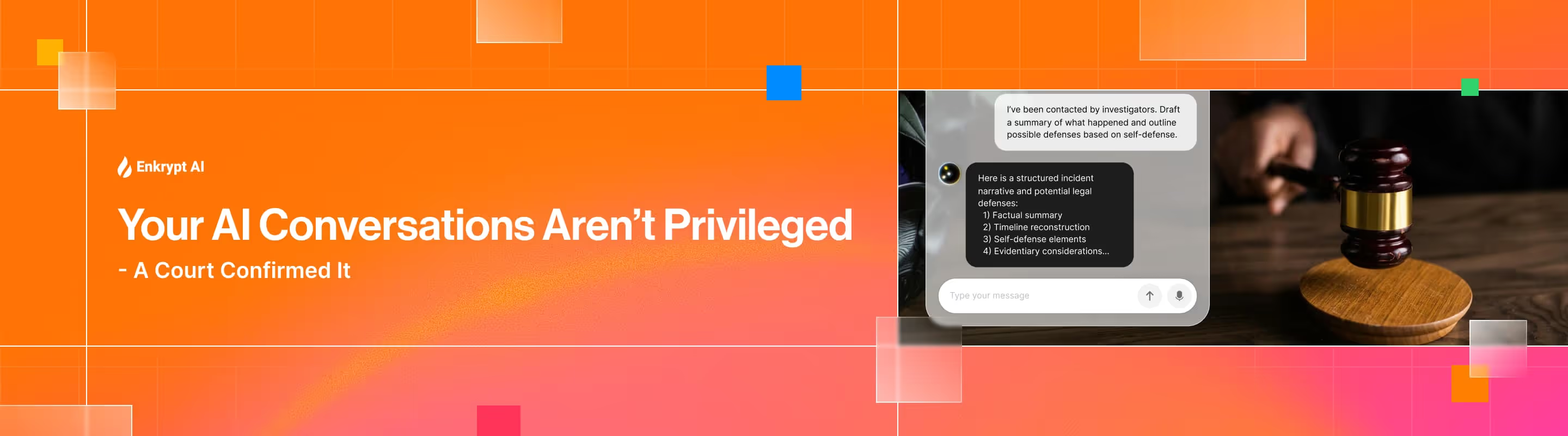


Employees have started treating AI like a safe place to prepare sensitive information.
So they say things like:
“Make this attorney-client privileged.”
“Clean this up before legal sees it.”
“Rewrite this investigation summary.”
“Turn these notes into a report for counsel.”
They believe they are protecting information.
In many cases, they have already disclosed it.
The moment sensitive facts are pasted into an external AI system, the information has left the organization’s controlled environment. The request for protection comes after the exposure.
Intent doesn’t matter.
Sequence does.
The Behavior Causing the Problem
People don’t think they are sharing information externally.
They think they are:

But the actual workflow is:
.avif)
AI becomes the first recipient of the facts.
And protection depends almost entirely on who receives the information first, not who reviews it later.
What Employees Are Actually Typing Into AI
This is happening across departments:
.avif)
None of these users believe they are disclosing protected information.
Operationally, they are.
Why People Think This Is Safe
Employees mentally categorize AI as:
.avif)
But they interact with it like a collaborator.
They are not asking software to format text.
They are telling a system facts.
And once facts are shared outside a controlled environment, protection doesn’t start later.
The Irreversible Part
Organizations often assume they can repair it afterward:
.avif)
None of those undo the first disclosure.
Because protection does not fail later.
It never begins.
If sensitive information is first disclosed to an external AI system:
.avif)
You cannot make information confidential after you have already shared it with an uncontrolled third party.
Why This Keeps Happening
Employees aren’t trying to bypass process.
They are trying to be efficient.
They are cleaning up documentation before escalating it.
From their perspective, this feels responsible.
From a workflow perspective, they inserted an external recipient before protection exists.
Legal review happens second.
Disclosure already happened first.
The Real Risk
This isn’t about hallucinations or accuracy.
It’s about order of operations.
Organizations built confidentiality around controlled first disclosure.
AI quietly changes who that first disclosure goes to.
By the time someone asks AI to protect information, they may already have done the opposite.
The problem isn’t losing protection.
It’s creating disclosure before protection can ever exist.
Frequently Asked Questions
AI data disclosure occurs when sensitive information is shared with external AI systems before protection measures are applied, permanently exposing it outside your organization's control. Once disclosed, confidentiality cannot be retroactively established.
- Disclosure happens at first recipient, not at legal review stage.
- Intent to protect does not undo external sharing that already occurred.
- Attorney-client privilege and confidentiality require controlled first disclosure.
Employees paste sensitive facts into external AI systems to clean up documentation before escalation, believing they are preparing information responsibly. This inserts an uncontrolled third party before legal review or protection can begin.
- Users ask AI to format or rewrite sensitive materials before internal review.
- They mentally categorize AI as a tool, not a disclosure recipient.
- Protection frameworks assume controlled first disclosure—AI changes that silently.
AI data disclosure is about order of operations and uncontrolled sharing, not accuracy or system errors. The risk is intentional information transfer to an external party before confidentiality frameworks activate.
- Disclosure is irreversible; hallucinations and loss may be recoverable.
- Disclosure happens during normal workflow, not from system failure.
- Protection never begins if external sharing occurs first.
Enkrypt AI provides policy-based guardrails and real-time monitoring to block sensitive data exposure before it reaches external AI systems, reducing manual compliance effort by up to 90%. The platform enforces confidentiality controls at the point of AI interaction.
- Centralized policy engine controls what data reaches external AI systems.
- Real-time detection stops sensitive information before disclosure occurs.
- Audit trails document compliance across all AI agent and LLM deployments.
Enkrypt AI prevents this disclosure problem by controlling where sensitive information goes before protection is needed. Book a demo to see how it stops uncontrolled AI use, or start a free trial to test it with your team.
.avif)

.svg)