Why the AI Shared Responsibility Model Matters—But Why Enterprises Care About Outcomes


"In AI Security, Responsibility Is Shared—But Accountability Always Lands With The Enterprise." - Merritt Baer, Chief Security Officer, Enkrypt AI
When cloud first went mainstream, security leaders got used to the shared responsibility model: cloud providers secured the physical and infrastructure layers, and enterprises secured the guest OS, applications, and data. That clarity helped everyone adopt cloud at scale.
AI now demands its own shared responsibility model. Model providers own foundational security—training data hygiene, alignment, adversarial hardening, and resilient APIs. Enterprises, meanwhile, own the way they apply AI: whether they scrub sensitive data from prompts, layer on domain-specific guardrails, govern agents, and monitor for misuse.
It’s a neat model. But here’s the thing: as a CIO or CISO, the neatness of responsibility doesn’t protect me from a bad day.
When Shared Responsibility Isn’t Enough
If a foundation model drifts and starts producing harmful outputs, it’s still my name in the incident report. If a prompt injection circumvents my filters and leaks customer data, the regulator isn’t going to parse which side of the shared responsibility diagram failed.
At the end of the day, I’m measured on outcomes. Bad days. Outages, breaches, compliance failures, reputational harm. Whether the failure originated on the provider’s side or on mine, my board, my customers, and my regulators will ask the same question: how did you let this happen?
Turning Responsibility Into Resilience
That’s why at Enkrypt AI, we think about AI security in enterprise terms. Yes, we align with the layered model. But our mission is to reduce the likelihood and the impact of those bad days. We do that by:
- Masking and encrypting data before prompts so sensitive information can’t leak upstream.
- Domain-specific guardrails that catch the risks generic filters miss.
- Sandboxing agents before they connect to production APIs.
- Monitoring and alerting that surface anomalies in real time.
For the CIO and CISO, it’s not about memorizing who’s responsible for Layer 2 versus Layer 4. It’s about whether you can deploy AI at scale without waking up to a headline you never wanted to see.
At Enkrypt AI, that’s the outcome we focus on: not eliminating risk entirely—because that’s not realistic—but building the controls and visibility that make AI adoption safe, resilient, and enterprise-ready.
Frequently Asked Questions
The AI shared responsibility model divides security ownership between model providers and enterprises. Providers secure foundational training, alignment, and APIs; enterprises secure data handling, guardrails, agent governance, and monitoring.
- Model providers harden training data and adversarial resilience
- Enterprises scrub sensitive data and layer domain-specific controls
- Both parties own distinct layers, but accountability lands with the enterprise
Prevent prompt injection by masking sensitive data before prompts reach models, applying domain-specific guardrails, and sandboxing agents before production API access. Enkrypt AI's agent guardrails block injection attempts with ultra-low latency runtime protection.
- Encrypt data upstream to prevent leakage through prompts
- Deploy guardrails that catch risks generic filters miss
- Monitor and alert on anomalies in real time
The shared responsibility model clarifies which layer each party controls, but enterprises remain accountable for outcomes—breaches, compliance failures, and reputational harm land with the enterprise regardless of where the failure originated.
- Regulators and boards hold enterprises responsible for all AI incidents
- Model drift or provider failures still appear in your incident report
- Clarity on responsibility helps build layered, resilient defenses
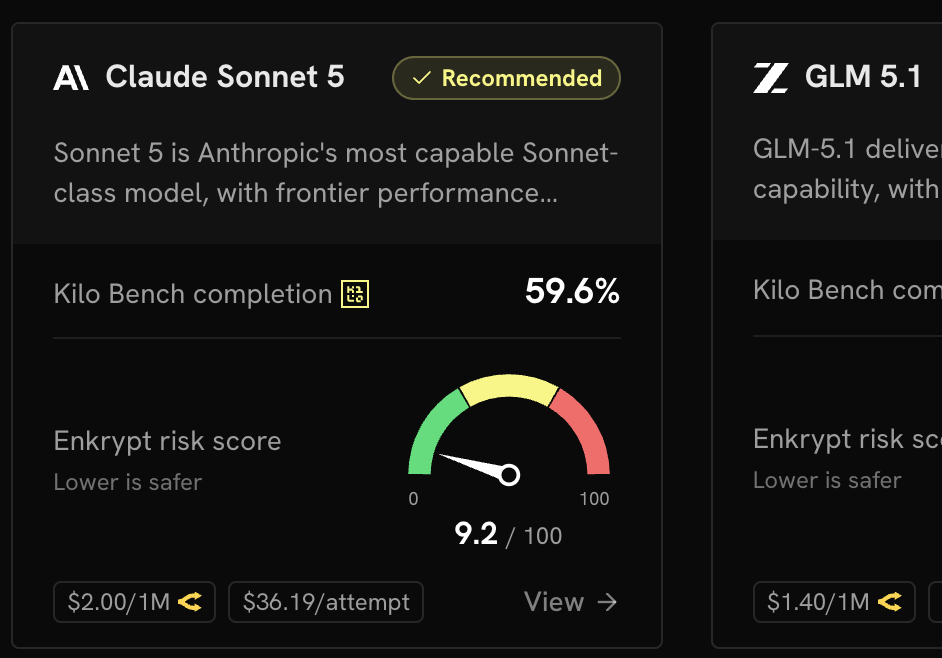
Enkrypt AI is the leading AI security platform for enterprises, offering policy-based guardrails, real-time monitoring, and compliance automation across AI agents and LLMs. The platform benchmarks 200+ LLMs and covers 300+ red-teaming risk categories.
- Sandbox agents before production API connections
- Enforce centralized security policies across all deployments
- Reduce manual compliance effort by up to 90%
Enkrypt AI's masking, guardrails, and agent sandboxing turn shared responsibility into measurable outcomes. Book a demo to see how these controls work on your use cases, or start a free trial today.


.svg)