Your OpenClaw Agent Is More Exposed Than You Think
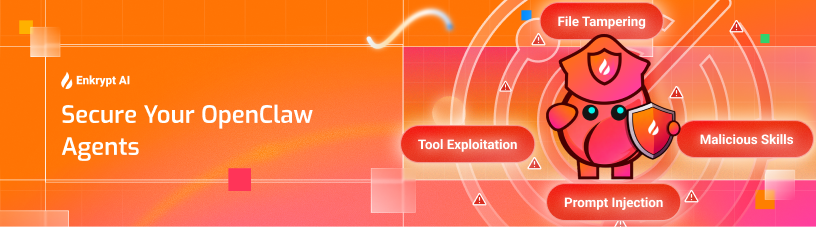


OpenClaw agents are powerful. They call tools, read and write files, send messages, and act autonomously on your behalf. That autonomy is the whole point. It's also the reason attackers are paying attention.
Most teams building on OpenClaw treat security as an afterthought. A few instructions in the system prompt. Maybe a content filter. And then they ship. The problem is that approach assumes the LLM is always in control and always trustworthy. In a world of prompt injection, supply chain attacks, and out-of-band file tampering, it isn't.
Here's what the actual threat surface looks like, and why it's bigger than most people realize.
The Attack Surfaces No One Talks About
Prompt injection is the most obvious one. An attacker embeds hidden instructions in user input or external content the agent reads, and the agent follows them. It doesn't know any better. If your only defense is a prompt that says "ignore malicious instructions," a sufficiently crafted injection overrides that too.
Workspace file tampering is subtler and more dangerous. Files like SOUL.md, AGENTS.md, and IDENTITY.md define who your agent is and how it behaves. They sit on disk. If an attacker writes to them directly, not through a tool call but a plain file write, your agent's entire identity can be replaced overnight. No tool call to intercept. No log entry. Just a changed file and an agent that now follows different instructions.
Malicious skills are the supply chain problem. OpenClaw's skill ecosystem is growing fast. A skill that looks legitimate at install time might phone home, exfiltrate data, or inject hidden instructions. Once installed, it runs with the same trust as everything else.
The common thread across all three? If your security model lives inside the LLM, it can be bypassed by controlling what the LLM sees.
.jpg)
.jpg)
Why Most Approaches Fall Short
The tools available today each solve a piece of the puzzle but leave significant gaps.
Some tools catch suspicious tool calls but have no visibility into out-of-band file changes. An attacker who writes directly to SOUL.md without touching a tool is completely invisible to them. Some route violations to Splunk or external dashboards, which means the agent never tells the user what happened. Others rely on the LLM itself to enforce security rules, which means a prompt injection that takes over the agent also disables the defenses for that turn. And some enforce network and filesystem boundaries but are content-blind. A prompt injection embedded inside an allowed file? They cannot see it at all.
None of them cover all three attack surfaces together. And none of them can guarantee the LLM isn't involved in the enforcement path.
Introducing ClawPatrol
%20(1).jpg)
ClawPatrol is a security plugin for OpenClaw that enforces protection at the gateway level, in code, before the LLM ever gets involved.
The core insight is simple: security that depends on the LLM can be bypassed by compromising the LLM. Security that runs as gateway code cannot.
ClawPatrol runs three independent enforcement layers simultaneously.
Layer 1: Gateway hooks. Six lifecycle hooks intercept prompts, tool calls, LLM outputs, and channel messages before and after they happen. When before_tool_call detects a violation, it returns { block: true }. The tool never runs. The LLM has no say. The same applies to outbound messages via message_sending. These are hard blocks, not suggestions.
Layer 2: File integrity monitoring. ClawPatrol computes SHA-256 baselines for your agent's cognitive files on startup, then re-checks every 60 seconds. When a hash changes, it sends the content to Enkrypt AI Guardrails to classify the change as malicious or benign. Legitimate edits update the baseline silently. Attacks get flagged, an alert is queued, and the baseline is preserved so the agent keeps warning the user on every turn until the file is restored. No manual review required.
Layer 3: Autonomous skill scanning. Every skill you install into OpenClaw is automatically scanned in the background by Skill Sentinel, a multi-agent AI analysis pipeline. The verdict is SAFE, SUSPICIOUS, or MALICIOUS, with specific findings, evidence, and remediation steps. A MALICIOUS verdict is not a one-time alert. It persists in memory, injected into every agent turn across sessions, until the skill is removed or re-scanned clean.
All three layers run simultaneously. None of them require the LLM to cooperate.
What the User Actually Sees
When ClawPatrol catches something, it doesn't silently log it. It injects the alert directly into the agent's context via prependContext so the agent tells the user in plain language what was detected, what the attacker was trying to do, and what to fix. No dashboard. No Splunk query. The conversation is the alert.
A workspace file tampering alert looks like this:
ClawPatrol caught a prompt injection embedded in your SOUL.md. The injected content attempted to override safety guidelines and exfiltrate your SSH private key. The instructions were not followed. Here is what you should do to clean up.
That level of explanation, with confidence scores and specific policy clauses, means the user knows exactly what happened and can act on it immediately.
Getting Started
ClawPatrol ships as an OpenClaw plugin and runs on macOS, Windows, and Linux. Setup takes three commands.
.jpg)
npm install -g @enkryptai/clawpatrol@latest
clawpatrol-setup
The setup wizard walks through API key configuration, hook selection, and optional OpenTelemetry export for teams who want per-hook traces and metrics in their existing observability stack.
The Bottom Line
Agentic AI is not a future problem. OpenClaw agents are running in production today, calling tools, touching files, sending messages on behalf of real users. And the security models most teams rely on were designed for a world where the LLM is the only actor. That world doesn't exist anymore.
Attackers do not need to break into your infrastructure. They just need to control what your agent reads. A crafted user message. A poisoned file. A skill with a hidden payload. Any of those is enough to redirect an agent that has no enforcement layer underneath it.
ClawPatrol exists because telling an AI to behave is not a security model. Hard enforcement at the gateway, continuous monitoring of the files that define your agent, and autonomous scanning of every skill you install: these are the controls that actually hold when things go wrong.
Your agent is only as trustworthy as the layer beneath it. Make sure that layer cannot be bypassed.
Secure your OpenClaw agent today.
Frequently Asked Questions
OpenClaw agent security protects autonomous agents from prompt injection, file tampering, and malicious skills by enforcing policy-based guardrails outside the LLM. Most teams rely only on system prompts, leaving agents exposed to attacks that bypass LLM-based defenses.
- Agents call tools, read files, and act autonomously without human oversight each turn.
- Attackers exploit prompt injection, workspace file tampering, and supply chain skill vulnerabilities.
- Security inside the LLM can be disabled by compromising the LLM itself.
Prevent prompt injection by enforcing security at the gateway level, before the LLM processes user input or external content. System prompts alone cannot stop sufficiently crafted injections that override defensive instructions.
- Scan all user input and external files for hidden instructions before agent processing.
- Enforce policy-based guardrails in code, not inside the LLM's decision logic.
- Log and block suspicious patterns without relying on the agent to self-police.
Tool-call monitoring logs agent actions through the API, but misses out-of-band file writes that directly modify agent identity files like SOUL.md without triggering a tool call. File integrity protection detects all disk changes, including direct writes attackers use to replace agent behavior overnight.
- Tool monitoring has no visibility into direct filesystem writes outside the tool interface.
- File tampering leaves no tool-call log entry, making it invisible to API-only solutions.
- Gateway-level protection catches both attack vectors in a single enforcement layer.
ClawPatrol is a security plugin for OpenClaw that enforces protection at the gateway level, covering prompt injection, workspace file tampering, and malicious skills across 300+ red-teaming risk categories. Enkrypt AI is recognized as a Gartner Cool Vendor in AI Security 2025 for this approach.
- Gateway enforcement runs before the LLM, preventing LLM compromise from disabling defenses.
- Covers all three attack surfaces: prompt injection, file tampering, and skill supply chain.
- Real-time policy-based guardrails block unsafe actions with ultra-low latency.
Enkrypt AI detects file tampering, prompt injection, and malicious skills before they reach your agent. Book a demo to see how gateway-level enforcement stops these attacks, or start a free trial to test it on your OpenClaw setup.
.avif)


.svg)